Showing posts with label big cat. Show all posts

Sunday, 17 November 2013

Global warming threatens Canada Lynx kittens.

The Canada lynx, often known as the Ghosts of the North, can be found thriving in the dense forests of Canada down to some of the northern states of the USA such as Maine, Montana, Washington, Oregon and Wyoming. Smaller populations are known to be living in other states, however in the year 2000 they were officially listed as a threatened species by the U.S. Fish and Wildlife Service due to poaching for fur.

Not to be confused with the similar looking Bobcat, these leggy felines are perfectly adapted for the snowy habitats in which they live, with their giant paws giving them the perfect advantage over other predators (Bobcats and Coyotes) when it comes to hunting the snowshoe hare that makes up the majority of their diet. They also have noticeable ear tufts that aid in hearing and are typically grey in colour compared to the spotted coat of the Bobcat.
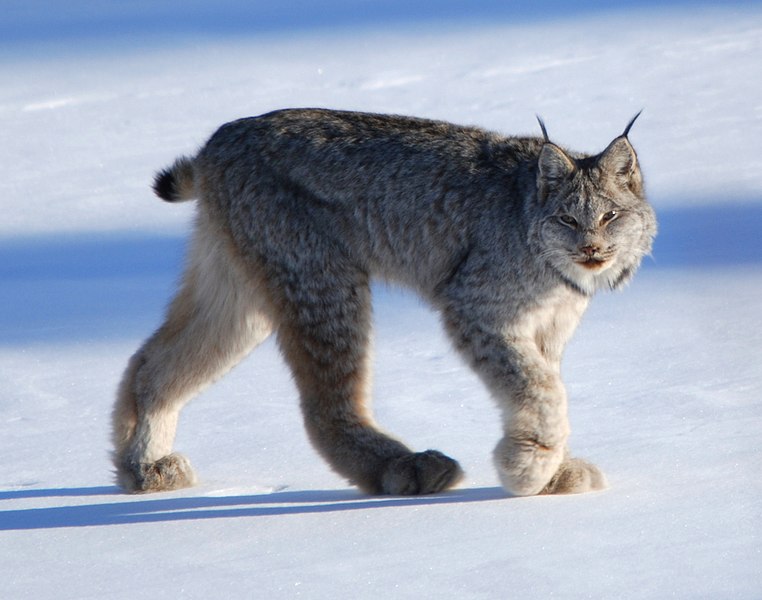
Photo credit: kdee64 (Keith Williams) on Flickr
Lynx kittens usually spend the first five weeks of their lives in a cosy den that the mother scopes out before she gives birth. They then follow her every move in order to learn the vital hunting skills they will need to survive by themselves. By 7-9 months of age they are able to hunt by themselves and are almost ready to leave home. Lynx are usually solitary animals but have been known to travel in small groups at times.

The habitats where these Lynx are found are known to have up to 2.7m of snowfall annually and this is just how the Canada Lynx likes it. However, the inevitable climate change is already decreasing snow fall and destroying the habitats that these cats depend on for survival.

New kittens may have a struggle on their hands (or paws) as this species is particularly sensitive to climate change. They rely so much on their physical adaptations to give them an advantage when hunting that, without the snowy landscapes, their physical attributes will be useless.
This may lead to less successful hunting and may cause the species to suffer further.

Friday, 15 November 2013

New fossil find reveals big cat origins.

The big cats, such as lions, tigers and leopards, are among some of the most successful predators on the planet, but when and where did they first arrive on earth?
Well a new fossil find may just give us the answer that has been long sought after!

Before now, the oldest big cat fossil was found on the continent of Africa and suggested that big cats were around 3.8 million years old. However, DNA comparisons have lead scientists to believe that big cats are in fact as old as 6 million years old...and now they have the bones to prove it.

Whilst carrying out their usual research and scoping out possible new digging sites on the Tibetan Plateau in Asia, Jack Tseng and his colleagues came across a discovery that is set to change scientific history. They discovered the skull of an ancient big cat - Panthera blytheae.
Usually digging up the bones of the native hoofed animals and the occasional rhino, this discovery brought excitement to the team as they carefully removed the remains from the fossil-rich ground.

Photo Credit: Gary Takeuchi
After further examination back in the Los Angeles lab, the scientists discovered that the animal they had dug up was in fact the ancient sister to the modern snow leopard. They had expected the remains to belong to the common ancestor of all living felids but bone comparisons put the animal distinctly on the snow leopard line.

Big cats were originally native to all continents except Australia and Antarctica and moved freely across continents when land bridges occurred due to a drop in sea levels.  When these land bridges disappeared, populations were isolated and eventually adapted and evolved to survive in their new environments. These adaptations eventually meant that original populations could no longer breed, giving rise to new species. This is how the big cat species that we know today would have come about and how they ended up in their current homes.

This discovery of the P. Blytheae skull, along with the remains of other species found nearby, help to paint a clear image of what the environment was like when these animals roamed the Tibetan Plateau and how they adapted and survived in the constant cold climates of that time.

Although this discovery was extremely exciting, it is not the end of the big cat story. As it was the sister of a modern snow leopard, it is clearly not the oldest fossil of its kind. Fossils still remain out there of the first ever common ancestors of the felines.
Scientists say that the more that is known about the success of ancient big cats under different environmental conditions, the easier it will be to predict their success to future changes.

Tseng says "studying these origins isn't just a sentimental things, in some ways it's a survival thing".